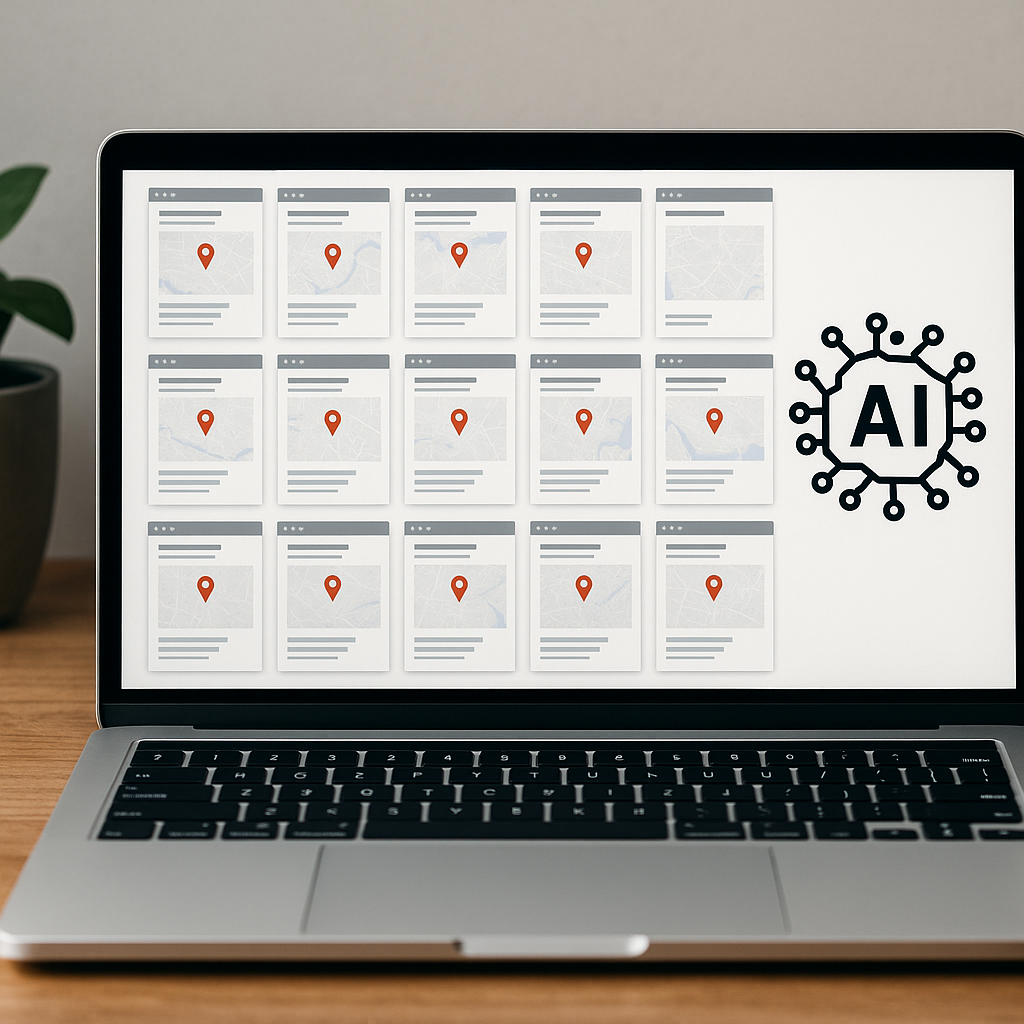
Local SEO is one of the most powerful strategies for businesses that serve specific geographic areas. But there is a long-standing challenge: creating unique, high-quality content for every location you serve is incredibly time-consuming. A plumbing company serving 50 cities, a dental practice expanding to 20 locations, or a real estate agency covering 100 neighborhoods — each needs dedicated landing pages with locally relevant content. Doing this manually could take months. With AI content for local SEO, you can accomplish it in days.
This tutorial walks you through the complete process of creating 100 or more location-specific pages using AI, from strategy and planning through execution and optimization. By the end, you will have a proven system for scaling local SEO content without sacrificing quality or uniqueness.
Why Location Pages Matter for Local SEO
Before we dive into the how, let us establish why location-specific pages are essential for local SEO success:
They Capture Location-Modified Searches
When users search for services in specific locations — "emergency plumber in Austin TX," "best dentist near downtown Chicago," or "SEO agency Berlin" — they expect to find content specifically relevant to that area. A generic services page cannot compete with a dedicated location page that addresses the specific needs, landmarks, regulations, and characteristics of that area.
They Signal Geographic Relevance to Search Engines
Google's algorithms use geographic signals to determine which pages to show for location-specific queries. Having a dedicated, well-optimized page for each location you serve sends strong geographic relevance signals that help you rank for local searches.
They Build Trust with Local Audiences
Users are more likely to engage with a business that demonstrates knowledge of and commitment to their specific area. A location page that mentions local landmarks, understands local challenges, and speaks to the community's specific needs builds trust far more effectively than a generic page.
They Scale Your Organic Traffic
Each quality location page is a potential entry point for organic traffic. If you serve 100 locations and each page generates even 50 visits per month, that is 5,000 additional monthly visitors — all with high local intent and strong conversion potential.
The Challenge of Creating Location Pages at Scale
Traditional location page creation faces several significant obstacles:
- Content duplication: Manually writing unique content for each location is tedious, and the temptation to use templates with only the city name swapped out leads to duplicate content penalties
- Time and cost: Writing genuinely unique content for 100 locations at a quality level that satisfies both users and search engines could take a writer months and cost thousands of dollars
- Local knowledge gaps: Writers may not have firsthand knowledge of every location, leading to generic content that lacks local authenticity
- Maintaining consistency: As page count grows, ensuring consistent quality, branding, and optimization across all pages becomes increasingly difficult
- Keeping content updated: Local information changes — new landmarks open, demographics shift, regulations change. Updating 100+ pages manually is a full-time job
This is exactly where AI-powered location content generation transforms the equation. Platforms like rankion.ai are specifically designed to solve these challenges, producing unique, locally relevant content at scale while maintaining quality and avoiding duplication.
Step-by-Step: Creating 100 Location Pages with AI
Step 1: Define Your Location Strategy
Before generating any content, develop a clear strategy for your location pages:
- List all target locations: Create a comprehensive list of every city, town, neighborhood, or region you want to target. Start with your primary service areas and expand from there.
- Prioritize by opportunity: Rank locations by search volume, competition level, and business importance. Start with high-priority locations where you have the strongest business presence or the greatest growth potential.
- Define your URL structure: Decide on a consistent URL pattern. Common approaches include:
/locations/city-name//services/service-name/city-name//city-name-service-name/
- Map keywords to locations: For each location, identify the primary keyword (e.g., "plumber in [city]") and secondary keywords (e.g., "emergency plumbing [city]," "24-hour plumber near [city]").
Step 2: Create Your Location Content Template
While each page's content should be unique, having a consistent structural template ensures completeness and optimization. A strong location page template includes:
- Hero section: Clear headline with location name, service description, and primary call-to-action
- Local introduction: Content connecting your service to the specific location, mentioning local context, challenges, or opportunities
- Services section: Detailed description of services available in this location
- Local expertise proof: Case studies, testimonials, or statistics from this specific area
- Area-specific information: Relevant local details like neighborhoods served, service hours, or regional considerations
- FAQ section: Location-specific frequently asked questions
- Contact and CTA: Location-specific contact information and strong call-to-action
Step 3: Prepare Your AI Content Generation
When using an AI platform like rankion.ai for location page generation, prepare the following inputs for each location:
- Location data: City name, state/region, population, notable features, neighborhoods
- Service specifics: Which of your services are available in this location
- Local differentiators: What makes your service unique or particularly relevant in this area
- Competitor landscape: Key competitors in this location
- Target keywords: Primary and secondary keywords for this location page
- Brand voice guidelines: Tone, style, and messaging framework to maintain consistency
The beauty of AI-powered platforms is that once you have this information organized, you can generate all 100 pages systematically with each one being unique and locally relevant.
Step 4: Generate Content with Anti-Repetition Controls
The critical differentiator between good and bad location pages is uniqueness. Search engines can easily detect when pages use the same content with only city names swapped. Your AI content generation process must include robust anti-repetition measures:
- Vary sentence structures: Each location page should use different sentence patterns, introductions, and transitions
- Incorporate unique local details: Reference specific landmarks, demographics, weather patterns, local events, and cultural elements unique to each location
- Diversify examples and scenarios: Use different case studies, examples, and use cases for different locations
- Adjust tone to local culture: Subtle variations in tone that reflect the character of each community
rankion.ai includes built-in anti-repetition technology specifically designed for this use case. The platform tracks content generated across all your location pages and actively ensures each page contains genuinely unique text — not just surface-level word substitution.
Step 5: Optimize Each Page for On-Page SEO
Every location page should be optimized for maximum search visibility:
- Title tag: Include both your service and the location name (e.g., "Expert Plumbing Services in Austin, TX | [Brand]")
- Meta description: Write a compelling description that includes the location and a clear value proposition
- H1 heading: Include the service and location (e.g., "Professional Plumbing Services in Austin, Texas")
- Header hierarchy: Use H2s and H3s with relevant local keywords
- Local schema markup: Implement LocalBusiness, Service, and GeoCoordinates schema
- Internal links: Link to related service pages, nearby location pages, and your main services hub
- NAP consistency: Ensure Name, Address, and Phone number are consistent with your Google Business Profile
Step 6: Implement Technical SEO for Location Pages
Beyond content and on-page optimization, ensure your location pages are technically sound:
- Page speed: Location pages should load in under 2 seconds. Optimize images, minimize code, and leverage caching.
- Mobile responsiveness: The majority of local searches happen on mobile devices. Your location pages must perform flawlessly on smartphones.
- XML sitemap: Include all location pages in your sitemap and submit it to Google Search Console.
- Canonical tags: Implement proper canonical tags to prevent any duplicate content issues.
- Breadcrumb navigation: Help users and search engines understand the relationship between your location pages and your site structure.
- Hreflang tags: If you serve locations in different language regions, implement hreflang tags for proper language and regional targeting.
Step 7: Build Local Signals Beyond Content
Great content is the foundation, but maximizing local SEO results requires additional signals:
- Google Business Profile optimization: Ensure your GBP listing is complete, accurate, and active for each location
- Local citations: Build consistent business listings across local directories for each service area
- Review strategy: Encourage customers in each location to leave reviews mentioning their city or neighborhood
- Local link building: Seek backlinks from local organizations, chambers of commerce, and community websites
- Social signals: Share location-specific content on social media and engage with local community groups
Avoiding Common Location Page Mistakes
Even with AI-powered content generation, there are pitfalls to avoid:
Mistake 1: Thin Content Pages
A location page with only 200 words and a swapped city name will not rank. Each page needs substantial, valuable content — aim for a minimum of 800-1,200 words of unique, locally relevant text. With AI tools like rankion.ai, generating this volume of unique content is straightforward.
Mistake 2: Creating Pages for Locations You Do Not Serve
Do not create location pages for areas where you cannot actually provide service. This violates Google's guidelines, damages user trust, and can result in penalties. Only create pages for locations where you have a genuine business presence or where you actually deliver services.
Mistake 3: Ignoring User Intent
Location page visitors have high commercial intent — they are looking for a service in their area and are often ready to take action. Make sure every location page includes clear calls-to-action, easy-to-find contact information, and straightforward next steps.
Mistake 4: Neglecting Internal Linking
Your location pages should not exist in isolation. Build a strong internal linking structure that connects related locations, relevant service pages, blog posts, and your main navigation. This helps both users and search engines discover and understand the relationship between your pages.
Mistake 5: Set-It-and-Forget-It Mentality
Location pages need ongoing maintenance. Local information changes, search algorithms evolve, and competitors enter the market. Plan for regular content audits and updates to keep your location pages competitive and accurate.
Case Study: Scaling from 5 to 100 Location Pages
To illustrate the impact of AI-powered location page creation, consider this real-world scenario:
A home services company originally had location pages for just 5 major cities, all written manually. After implementing an AI-powered location content strategy using rankion.ai, they expanded to 100 location pages covering every suburb and neighboring city in their service area.
Results after 6 months:
- Organic traffic increase: 340% growth in organic traffic from local searches
- Keyword rankings: Ranking in the top 10 for 78% of target location-keyword combinations
- Lead generation: 4.2x increase in contact form submissions from organic search
- Cost per lead: 65% reduction compared to paid advertising for the same locations
- Time investment: 100 pages created in 2 weeks vs. an estimated 6 months for manual creation
Advanced Strategies for Location Page SEO
Programmatic Location Content
For businesses with extremely large location needs (500+ cities), consider a programmatic approach where AI-generated content is dynamically integrated with structured location data. This allows you to maintain a database of location-specific information that automatically populates your page templates while AI generates the unique narrative content for each page.
Location Content Clusters
Build content clusters around your key locations. In addition to the main location page for each city, create supporting content like local blog posts, area guides, and neighborhood-specific pages. This approach builds topical depth and geographic authority that strengthens the ranking potential of all pages in the cluster.
Dynamic Content Updates
Use AI to periodically refresh your location pages with updated local information — new statistics, seasonal content variations, or responses to current local events. This keeps your content fresh and signals to search engines that your pages are actively maintained.
Conclusion
Creating 100 or more location pages with AI is not just possible — it is now the most efficient and effective approach to local SEO at scale. The combination of AI content generation, anti-repetition technology, and built-in SEO optimization allows businesses to create genuinely unique, locally relevant, search-optimized content for every area they serve.
Platforms like rankion.ai have made this process accessible to businesses of all sizes, from small local companies expanding their service areas to large enterprises managing hundreds of locations nationwide. The technology handles the content creation, leaving you free to focus on strategy, quality assurance, and business growth.
Start with your highest-priority locations, validate the approach with real ranking results, and then scale systematically. With the right AI tools and a solid strategy, 100 location pages is not an ambitious goal — it is just the beginning.