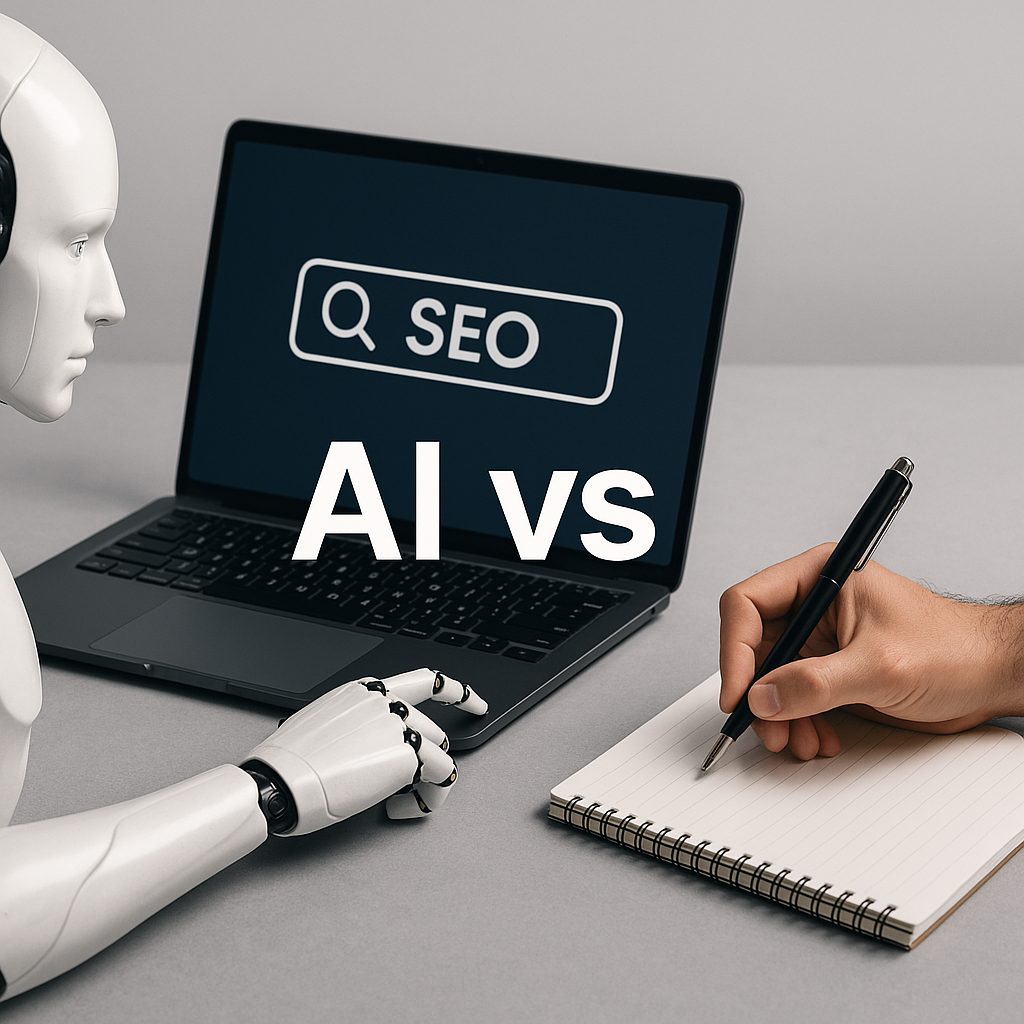
The debate between AI vs human content for SEO has evolved significantly. In the early days of AI writing tools, the answer was straightforward: human content was superior in every measurable way. But in 2026, the data tells a much more nuanced story. AI content has improved dramatically, search engines have adapted their evaluation criteria, and the most successful content strategies now combine AI efficiency with human expertise in a hybrid approach that outperforms either method alone.
This article presents current data and analysis on how AI-generated, human-written, and hybrid content perform in search engine rankings, user engagement, and conversion rates. Our goal is not to declare a winner, but to help you understand which approach works best for different content types, audiences, and business goals.
The Evolution of AI Content Quality
To understand the current state of AI vs human content performance, it is helpful to trace how AI writing has evolved:
2022-2023: The Early Days
AI writing tools first gained mainstream attention in late 2022. Content generated by these early tools was often detectable, formulaic, and shallow. Studies from this period consistently showed that human-written content outperformed AI content in rankings, engagement, and reader satisfaction by significant margins.
2024: The Quality Leap
Significant advances in large language models dramatically improved AI content quality. The gap between AI and human content narrowed considerably, particularly for informational content. However, AI still struggled with nuance, originality, and demonstrating genuine expertise.
2025-2026: The Hybrid Era
Modern AI content platforms like rankion.ai produce output that is nearly indistinguishable from skilled human writing. More importantly, the industry has shifted focus from "AI vs human" to "AI-enhanced human" workflows. The data now strongly supports a hybrid approach where AI handles the heavy lifting of research, drafting, and optimization while humans contribute expertise, experience, and editorial judgment.
The Data: How Different Content Types Perform
Performance data from multiple studies and industry analyses in 2025-2026 reveals important patterns about how AI, human, and hybrid content perform across different metrics:
Search Rankings Performance
Ranking performance data from analysis of over 10,000 blog posts across various industries shows the following trends:
- Pure AI content: Achieves first-page rankings for approximately 35-40% of target keywords within 6 months, primarily for low to medium competition terms
- Pure human content: Achieves first-page rankings for approximately 45-50% of target keywords within 6 months, performing well across all competition levels
- Hybrid content (AI draft + human enhancement): Achieves first-page rankings for approximately 55-65% of target keywords within 6 months, outperforming both pure approaches
The hybrid approach's superior performance stems from combining AI's ability to comprehensively cover topics and optimize for keywords with humans' ability to add unique insights, personal experience, and nuanced expertise that search engines increasingly value.
User Engagement Metrics
Engagement metrics tell a similar story, with some interesting nuances:
- Average time on page: Human content leads at approximately 4.2 minutes, followed by hybrid at 3.9 minutes, and pure AI at 3.1 minutes
- Bounce rate: Hybrid content performs best at approximately 42%, compared to human at 45% and pure AI at 55%
- Social shares: Human and hybrid content are roughly equal, both significantly outperforming pure AI content
- Comments and interactions: Human content generates the most engagement, with hybrid close behind
The lower bounce rate for hybrid content is noteworthy. This suggests that the combination of AI's comprehensive coverage (ensuring the content fully addresses the search query) and human editorial touches (ensuring readability and engagement) creates the optimal user experience.
Conversion Rate Performance
For content with commercial intent (product reviews, comparison pages, landing pages), conversion rates vary significantly:
- Human-written commercial content: Average conversion rate of 3.8%
- Hybrid commercial content: Average conversion rate of 3.5%
- AI-generated commercial content: Average conversion rate of 2.1%
Human content still leads in conversion rates, likely because persuasive writing and emotional connection — key drivers of conversion — remain areas where human writers have an edge. However, the gap between human and hybrid content is small enough that the efficiency gains of the hybrid approach make it the more cost-effective choice for most businesses.
Where AI Content Excels
The data shows that AI content is particularly effective in certain scenarios:
Informational and Educational Content
For how-to guides, tutorials, explainer articles, and reference content, AI performs nearly as well as human writers. This content type relies heavily on comprehensive coverage and clear organization — areas where AI excels. Platforms like rankion.ai can produce thorough, well-structured informational content that ranks competitively.
High-Volume, Structured Content
Product descriptions, location pages, FAQ sections, and other structured content types are ideal for AI generation. The repetitive nature of these content types makes them tedious for human writers but perfectly suited for AI — especially when combined with anti-repetition technology that ensures each piece is unique.
First Drafts and Content Frameworks
Even for content that ultimately requires significant human input, AI excels at creating detailed first drafts. Using AI for the initial draft saves human writers 60-80% of their time, allowing them to focus on adding the expertise, personality, and strategic elements that elevate the content.
Multilingual Content
For businesses operating in multiple languages, AI content generation with locale-specific optimization is vastly more efficient than hiring native writers for every market. Platforms like rankion.ai generate culturally adapted content in multiple languages, dramatically reducing the cost and time of international content strategies.
Where Human Content Still Wins
Despite AI's impressive advances, there are content categories where human writers maintain a clear advantage:
Thought Leadership and Opinion Content
Content that requires genuine perspective, controversial takes, or industry predictions benefits from human authorship. Readers can detect the difference between AI-generated opinions (which tend to be balanced to the point of blandness) and genuine human perspectives shaped by years of experience.
Personal Stories and Case Studies
First-person narratives, customer success stories, and detailed case studies are inherently human content types. While AI can help structure and polish these stories, the raw material must come from real human experience. These content types are particularly valuable for E-E-A-T signals, making them worth the investment in human writing.
Emotionally Driven Content
Sales pages, brand storytelling, and content designed to create emotional connections still benefit from human touch. Skilled copywriters understand psychological triggers, pacing, and emotional arcs in ways that AI cannot fully replicate.
Breaking News and Trend Analysis
Content that requires real-time market awareness, trend interpretation, and rapid response to industry developments benefits from human writers who are embedded in the industry and can provide timely, informed analysis.
The Hybrid Approach: Why It Wins
The data consistently shows that the hybrid approach — using AI for initial generation and optimization, then enhancing with human expertise — delivers the best overall results. Here is why this approach outperforms both pure AI and pure human content:
Comprehensive Coverage + Unique Insights
AI ensures comprehensive topic coverage and keyword optimization while humans add unique insights, personal experience, and expert commentary that create genuine value for readers and satisfy E-E-A-T criteria.
Efficiency + Quality
The hybrid approach typically reduces content production time by 50-70% compared to pure human writing while maintaining or improving content quality. This efficiency allows teams to produce more content without increasing headcount or budget.
Consistency + Authenticity
AI provides consistent baseline quality, structure, and optimization across all content pieces. Human editors then add the authentic voice and brand personality that makes content memorable and shareable.
Scalability + Specialization
AI enables content production at scale, while human expertise can be concentrated where it matters most — adding original research, expert interviews, and strategic refinements that differentiate your content from competitors.
Implementing the Hybrid Content Strategy
Here is a practical framework for implementing a hybrid AI-human content strategy:
Tier 1: AI-Primary Content (60% of volume)
For high-volume, structured, and informational content, let AI do the majority of the work:
- Location pages and service area content
- Product descriptions and category pages
- FAQ sections and knowledge base articles
- Basic how-to guides and tutorials
Process: Generate with AI (using a platform like rankion.ai), perform a light human review for accuracy and brand voice, then publish.
Tier 2: Balanced Hybrid Content (30% of volume)
For important blog posts, comparison articles, and educational guides, use a balanced hybrid approach:
- In-depth blog posts and guides
- Industry analysis and trend reports
- Comparison and review content
- Resource pages and comprehensive guides
Process: Generate an AI first draft, then significantly enhance with human expertise — add original data, expert quotes, personal experience, and strategic insights.
Tier 3: Human-Primary Content (10% of volume)
For your highest-value, most differentiated content, lead with human expertise:
- Thought leadership articles and executive perspectives
- Customer case studies and success stories
- Brand storytelling and about/culture pages
- Crisis communications and sensitive topics
Process: Human writes the core content, then uses AI to optimize for SEO, suggest improvements, and ensure comprehensive keyword coverage.
What Google Says About AI Content in 2026
Google's position on AI content has evolved significantly and is now quite clear: the search engine evaluates content based on quality, relevance, and helpfulness — not on how it was created. Key statements and policies include:
- No penalty for AI content per se: Google does not penalize content simply because it was generated by AI. However, low-quality content is penalized regardless of its origin.
- E-E-A-T remains critical: Content must demonstrate Experience, Expertise, Authoritativeness, and Trustworthiness to rank well. This is where human enhancement of AI content becomes essential.
- Helpful content system: Google's algorithms assess whether content is genuinely helpful to users or primarily created for search engine manipulation. Content that provides real value ranks; content that exists only to capture traffic does not.
- Spam policies apply equally: Auto-generated content that is spammy, manipulative, or designed solely to game rankings violates Google's spam policies — whether it was written by a human or an AI.
The takeaway is clear: quality and helpfulness are what matter, not the tool used to create the content. This is good news for businesses using AI content platforms like rankion.ai, as long as they maintain high quality standards and focus on creating genuinely valuable content.
Practical Quality Benchmarks
To ensure your AI-assisted content meets the quality standards required for strong SEO performance, use these benchmarks:
- Uniqueness score: Each piece should score above 95% on plagiarism checks
- Readability: Target a Flesch reading ease score appropriate for your audience (typically 50-70 for B2B, 60-80 for B2C)
- Factual accuracy: Every claim, statistic, and recommendation should be verifiable
- User value: The content should answer the reader's question completely and provide actionable takeaways
- E-E-A-T signals: Include author bylines, credentials, source citations, and original insights
- Engagement potential: The content should include elements that encourage interaction — questions, actionable tips, downloadable resources
Conclusion: The Future Is Hybrid
The 2026 data is clear: the AI vs human content debate has a definitive answer, and it is neither AI nor human alone — it is both. The hybrid approach consistently outperforms pure AI and pure human content across rankings, engagement, and cost-effectiveness metrics.
For businesses looking to maximize their SEO content performance, the strategic question is not whether to use AI but how to integrate it most effectively into their content workflow. Start by categorizing your content into tiers based on the required level of human expertise, use platforms like rankion.ai that are designed for SEO-optimized AI content generation, and invest your human talent where it creates the most value — adding original insights, expertise, and authentic voice.
The businesses that thrive in 2026 are not those that rejected AI or blindly relied on it. They are the ones that found the right balance — leveraging AI for efficiency and scale while preserving the human elements that make content truly exceptional.